

Reader Poll
With Sony Playstation announcing the end of physical games tell us what you think!
Log in to vote in this poll.
Results
Total votes: 1
On July 1, 2026, Sony Interactive Entertainment announced a tectonic shift for the gaming industry: by January 2028, the company will completely end physical disc production for all new games across PlayStation consoles (Sony). While corporate executives view this transition as a natural adaptation to digital consumer trends, the reality on the ground paints a much darker picture. Moving to an exclusively digital ecosystem is not just an evolution—it is a digital lockout that actively excludes millions of players due to infrastructure disparities, strips consumers of fundamental rights, and risks erasing modern cultural heritage.
The Global Infrastructure Mirage
The core flaw in a digital-only marketplace is the flawed assumption that every player has access to reliable, high-speed fiber internet. According to global development data published by the International Telecommunication Union (ITU), approximately 2.2 billion people remain completely offline worldwide (ITU). For those who are online, internet access is highly fractured. The ITU notes that digital infrastructure remains deeply divided by geography and income, meaning non-metropolitan and lower-income regions lack the robust pipelines found in major cities (ITU).
Data tracked by the World Bank reinforces this reality, showing that median download speeds in rural and developing markets frequently plateau well below 30 Mbps, failing to keep pace with high-income metropolitan areas (World Bank 6).
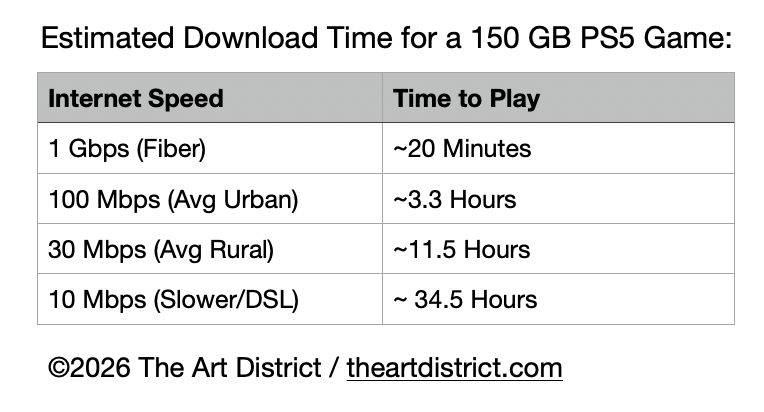
In an era where modern blockbuster PlayStation 5 titles routinely require installation footprints ranging from 100 GB to over 185 GB, these bandwidth limitations present a massive roadblock. For a consumer on a standard 30 Mbps connection, downloading a single 150 GB game requires nearly twelve hours of continuous, uninterrupted downloading. For those with slower or less stable connections, that timeline stretches to several days. A digital-only market essentially levies a geographic tax on players outside major infrastructure hubs. It means buying a game on launch day no longer guarantees the ability to play it on launch day. Physical media circumvents this entirely, offering instant, out-of-the-box accessibility.
Reframing Indefinite Renting as Ownership
Beyond the immediate logistical barriers, killing the physical disc fundamentally reshapes consumer rights. When you purchase a physical game, you possess a tangible asset protected by decades of legal precedent. As digital rights advocates at the Electronic Frontier Foundation (EFF) point out, physical media carries the “right of first sale”. This legal doctrine ensures that you genuinely own your copy, allowing you to lend it to a friend, donate it to a library, or resell it on the secondary market (Mir).
Digital distribution operates under a completely different framework. Digital storefronts do not sell you a game; they sell you a conditional, non-transferable license to access a file (Mir). You cannot resell it, you cannot pass it down, and you cannot give it away. By eradicating physical discs, Sony is effectively trapping players in a closed system where consumer rights are severely diminished, turning gamers from owners into permanent renters.
Preserving Our Cultural Heritage
Video games are no longer a niche pastime; they are a defining, multi-billion-dollar modern art form. Yet, digital-only ecosystems are notoriously hostile to historical preservation. When a digital storefront closes, or when licensing agreements expire, digital-only games can vanish overnight. We have already seen this occur with digital-exclusive titles across previous console generations that are now entirely unplayable and lost to history.
Physical media acts as a vital decentralized archive. Discs ensure that creative achievements remain permanently accessible to historians, academic institutions, specialized archivist groups, and everyday players. They safeguard interactive art independently of corporate servers, DRM validation checks, or corporate bankruptcy.
A Call for Preservation and Equity
Sony Interactive Entertainment has built its legendary legacy on the backs of passionate players worldwide. Forcing a digital-only future by 2028 turns its back on the very community that built the PlayStation brand—particularly those isolated by infrastructure inequalities.
Innovation should expand access, not restrict it. Sony must maintain a dedicated avenue for physical manufacturing, whether through limited production windows, boutique publishing partnerships, or print-on-demand services. Preserving the physical disc is not a regression; it is a necessary commitment to digital equity, consumer freedom, and the survival of gaming history.
Works Cited
International Telecommunication Union (ITU). “ITU Statistics Update – December 2025.” ITU DataHub, 31 Dec. 2025, www.itu.int/en/ITU-D/Statistics/Pages/StatisticsUpdate/December2025.aspx.
Mir, Rory. Quoted in “From Game Owner to Indefinite Renter: Your Rights as a Gamer.” Startup Daily, 14 July 2026, www.startupdaily.net/after-hours/gaming/gaming-from-game-owner-to-indefinite-renter/.
Sony Interactive Entertainment. “Physical Disc Production Ending in January 2028 for New Games Releasing on PlayStation Consoles.” PlayStation.Blog, 1 July 2026, playstation.com.
World Bank. Digital Foundations for Growth: Infrastructure and Economic Trends Report. World Bank Group, Dec. 2025, pp. 6-12, thedocs.worldbank.org/en/doc/2058d67adda4a910ceab72209ddec8f3-0070012025/related/IEP-December-2025-Digital-Presentation.pdf.